Concrete contractor in Long Beach, CA
Patios, driveways, pool decks, walkways and foundations for Long Beach homes and businesses, built for the soil and weather here.
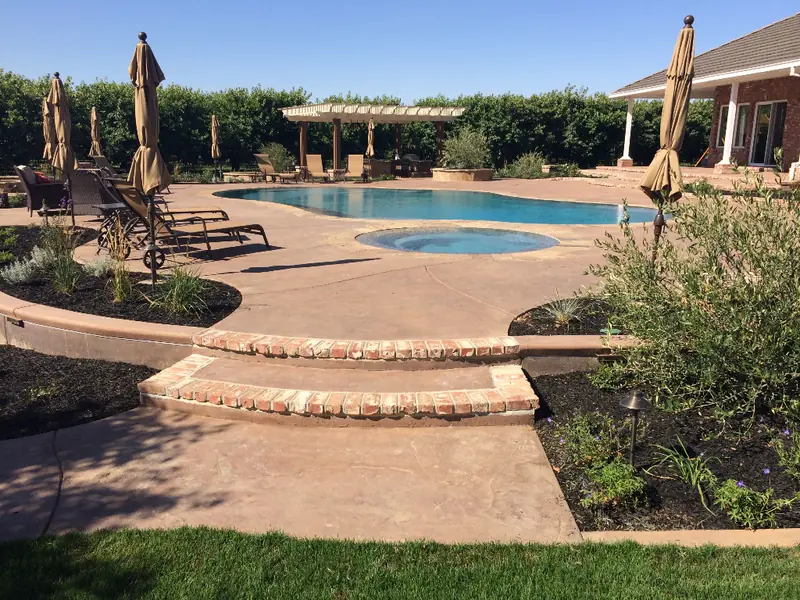
Long Beach is a coastal city, and three things work against fresh concrete here: soil that moves with moisture, salt air near the water, and heat and wind that dry a slab faster than most people expect. Each one changes how we prep, pour and cure.
Why concrete work here is different
Soil that moves
Parts of the LA basin sit on clay that swells when it gets wet and shrinks when it dries out. Los Angeles County's building code treats slab-on-grade foundations on expansive soil as a special case and requires them to follow its Section 1805.8 or a geotechnical design approved by the building official. A patio or driveway is not a foundation, but it sits on the same ground. Base depth, compaction and drainage depend on what is under the job, so we look at the soil before we set forms. [[CONFIRM: our standard base depth and compaction spec for Long Beach patios and driveways]]
Ground near the water can be sandier, which drains and compacts differently from clay. [[CONFIRM: sandy soil near the coast in our service area]] Slab thickness and control joint spacing follow the same logic: a thin slab on weak base cracks, and a joint cut late cracks where it wants to. [[CONFIRM: slab thickness and control joint spacing we use for driveways and patios]]
Salt air near the water
Blocks closest to the ocean get sea spray and a marine layer. Chloride from sea air falls off quickly with distance from the water, and it can reach the steel inside a slab, so the streets nearest the coast see the most exposure. A sealer and enough rebar cover are the usual answers. [[CONFIRM: sealer product and rebar cover we use on slabs close to the water]]
Heat and Santa Ana wind
On a hot, dry, windy day, water leaves fresh concrete faster than it can rise to the surface. That is how plastic shrinkage cracks form before the finish is even done. Santa Ana wind events mostly come in the cooler months, from fall through winter, and they can drop humidity sharply and push wind across a pour. Summer heat speeds up setting. We plan pour times around the forecast and cover fresh work fast. [[CONFIRM: wind and temperature limits that make us move or postpone a pour]]
Neighborhoods we serve in Long Beach
- Bluff Park: a designated historic district from 1982, with Craftsman bungalows and period revival homes mostly built from 1903 to 1949.
- Bluff Heights: Craftsman bungalows built roughly 1910 to 1923, designated a historic district in 2004.
- California Heights: the city's largest historic district, with Craftsman bungalows, Spanish Colonial Revival and Tudor Revival homes.
- Belmont Heights: a historic district since 2002, where Craftsman bungalows make up most of the homes.
- Park Estates: mid-century homes on larger lots, developed from 1948. Local coverage notes that several were designed by well-known architects.
- Los Altos: mid-century single-family tract homes.
- The Plaza: post-war single-family homes. [[CONFIRM: The Plaza boundaries and housing era]]
- Lakewood Village: a Long Beach neighborhood on the edge of Lakewood, with early 1950s tract homes.
Permits, historic districts and HOAs
Two offices matter for most jobs. Building permits go through Long Beach Development Services. Work in the public right of way, such as a new driveway approach, a curb cut or a sidewalk, usually needs a separate permit from Public Works. The city's Public Works team says it manages right-of-way permits for residential projects, including driveways and sidewalks. [[CONFIRM: whether a driveway replacement with no curb cut change needs a Public Works permit]]
The city has designated 18 historic districts, and California Heights, Bluff Park, Bluff Heights and Belmont Heights are among them. Exterior changes in a district can need review before work starts, and Bluff Park has its own design guidelines. [[CONFIRM: whether driveway, walkway and patio changes in a designated district need historic review, and how long that takes]]
Some newer condos and planned tracts have HOAs with their own rules on materials, colors and hardscape. Check the CC&Rs before you sign. [[CONFIRM: typical permit turnaround in Long Beach]]
Most requested work for Long Beach homes
Craftsman lots usually ask for front walks, porch steps, driveway strips and side-yard patios. Mid-century homes in Park Estates and Los Altos often want a patio that opens onto a larger backyard, and pool decks where there is a pool.
- Walkways for front walks and porch approaches.
- Driveways, including driveway strips for narrow lots.
- Patios for side yards and backyards.
- Pool decks for mid-century backyards.
- Stamped and decorative concrete for patios and entries.
- Retaining and block walls on sloped lots.
- Foundations and ADU pads for backyard additions.
- Removal and replacement when an old slab has to come out first.
Send the street address and a few photos of the area, and we will tell you what the soil, permits and historic rules look like before we quote. Request a quote, call (657) 300-7519, or text us.
Get a quote for your Long Beach project
Send us the basics online, or call or text (657) 300-7519. We come out, measure and price it in writing.